
In my recent review of Chris Priestleys Mister Creecher'I mused on how humanity and physicality are inextricably tied: no matter how transcendant one aims to be intellectually, ethically, and spiritually, ones humanity will always be judged, at the outset at least, by how well one meets the physical criteria of humanness. The idea is nothing new, and its one thats been explored throughout literature, with those who are deformed or physically disabled subject to being shunned or isolated.'In particular, its an idea thats looked at in postapocalyptic fiction, and to a lesser extent dystopian fiction. Curiously, these deformities are always the result, whether directly or indirectly, of scientific advances: in this genre, such advances either seem to result in genetic manipulation or all-out warfare.
HG Wells, for example, warns against godless scientific tinkerings in The Island of Doctor Moreau'(review)'and The Invisible Man'(review), while'John Wyndhams The Chrysalids (review)''looks at a postapocalyptic society in which deformities across the entire natural world have become the norm.'And there are countless novels, ranging from Margaret Atwoods'The Handmaids Tale'through to more recent works such'Birthmarked'by Caragh OBrien'(review), where systemic female sterility is the result of our intellectual foibles. Its impossible not to see a moral dimension in these: there are echoes of The Scarlet Letter'in both the Atwood and the OBrien, and the'disturbing renegotiation of the perception of women in society is starkly confronting. Similarly, Wyndhams characters see physical deformity as a moral aberration, not sheer genetic ill-luck, and Wells spends a good deal of time examining the breakdown of humanity in the subjects of his books.
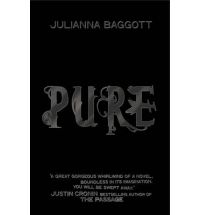
Pure, the highly anticipated dystopian release from Julianna Baggott, incorporates all of the above, with an all-encompassing approach to the genre that blends not only postapocalyptic elements but dystopian ones as well. Baggotts world is one devastated by the detonations, a series of blasts designed, it seems, to wipe clean the slate of humanity in order that we can begin once more anew. A select group of pures is isolated within the controlled environment of a dome, while those who do not meet these criteria are left behind to fend for themselves in the desolation that follows. The parallels to World War II are palpable, with the bombings of Hiroshima and Nagasaki looming large in the shadow of the detonations, and the eugenics approach taken by those in power all too evident. (There is a weird irony, though, that the pures are ghettoed in the dome, with the rest of the world ostensibly, although admittedly more in theory than in reality, unfettered around them.)
This sense of history repeating brings to mind'Walter M Millers novel'A Canticle for Leibowitz, which occurs some several hundred years after the flame deluge. In Millers classic, genetically ravaged misborns, also known as the Popes Children, roam the earth, and anti-intellectualism is rife, with science and learning demonised as having facilitated the nuclear holocaust. Millers narrative approach is cyclical, with humanity slowly rebuilding its technological prowess only to become seduced by its power once more, and there are echoes of the same happening in Pure. Not only do we see parallels between WWII and the detonations, but also the ceaseless efforts of the pures towards self-improvement. Where the wretches left behind seem, at least superficially, to be doing little more than surviving, those within the dome are constantly self-experimenting, undertaking trials to improve themselves physically and intellectually. There are echoes of Wyndham here, with the drive for perfection or purity being linked to moral superiority. And indeed, like the Wyndham there are consequences of imperfection: whole crops, for example, are destroyed if they reveal any sort of abnormality that diverges from mainstream perfection.
But the issue with the pures efforts to regain supremacy is that their efforts require involved artificial adaptation. They strive to recreate the agriculture and livestock of old, yet are doing so by forcing these approaches on to a landscape that is utterly changed. Moreover, their own artificial adaptations are conducted with a view to eventually being able to survive in the outside world once it is again inhabitable, but yet theyre doing so without engaging at all with this world. In contrast, its the wretches on the outside who are best adapted for survival. Curiously, theyve undergone adaptation of their own (some vague thing to do with nanotech thats resulted in their becoming fused to whatever organic or inorganic matter was close to them at the time of the detonations), and despite their physical deformities, are doing a surprisingly decent job of surviving in what is little more than a wasteland.
The idea of these fusings recalls of China Mievilles Perdido Street Station, in which criminals are remade and made monstrous through terrifying amputations and Frankensteinian additions, and where there exists a group of fReemade, escaped remade criminals. In Pure, as can no doubt be extrapolated from the not-so-subtle title, these physical deviations are a political statement of sorts, and are given overwhelming emphasisbut to, in my opinion, the detriment of the plot. Astonishing amounts of page space are given over to describing the endless horrific ways in which humans can be melded with cars, childrens toys, glass, animals and even other people. So much, in fact, that this almost become the point of the book. And though theres a hazy sense of politicisation surrounding it all, Baggott is so vague on the political context that its all rather meaningless.
This is unfortunately true throughout the book: theres an odd sense of Pure'being less a story and more a setting: its almost as though the author uses her pen to pan across the landscape rather than to allow the reader to engage with it. Perhaps, of course, thats the pointafter all, the pures look out, benevolently, from afar, from their domed world, but are otherwise utterly disengaged from the reality of it all. But as a reader, it does become tiresome.'It takes some several hundred pages for the plot to truly kick into gear, and when it does things become increasingly shaky. Baggott uses the affordances of anti-intellectualism and revisionism to glaze over the social and political circumstances behind the detonations, but where this approach works in novels such as 1984'or Brave New World (review), where there are solidly rendered socio-political contexts and where propaganda is carefully used to manipulative effect, in Pure'it simply feels like handwavium: the characters are rendered ignorant so that any concrete information need not be imparted to the reader. Baggott does seem to make her own attempt at the Two Minutes Hate in that there are constant repetitions and recurring motifs: protagonist Pressias deformed hand is mentioned more times than I can count, and the word fused is an endless refrain. The intention seems to be one of desensitisation through repetition, but the result is a book that feels painfully tautological.''The narrative voice, unfortunately, strikes with the same dullness as the endless repetition of doll-head fist and fusing: dirge-like sentences, soulless descriptions of destruction and despair, and a general wallowing hopelessness.
This repetition is true of the characters as well. Though the book switches between four points of view, two of which in my opinion are extraneous, the voice is unchanging throughout, which seems strange given that two of the point of view characters are uneducated wretches, while the others are hyper-privileged dome dwellers. I also found it curious that the two key wretch characters were only deformed in a minor way. Though those around them are scarred or changed almost beyond recognitionand often beyond functionPressia sports a moon-shaped scar around one eye and a doll-head fist, while Bradwell has been fused with a flock of birds, leaving his back aflutter with wings. Theres a slightly canted sense of beauty to their deformities, and I find it interesting that the author chose two relatively unaffected characters to contrast with the pures.
Perhaps Pures biggest strength is that it draws so strongly on much of the superb dystopian and postapocalyptic fiction that precedes it, making it a useful summation of a lengthy reading list. But as a novel in its own right, Im afraid I feel that it doesnt offer much thats newand in a genre thats so oversaturated as this one, a book needs more than a beautifully rendered setting to truly stand out.
Rating: 
 (good)
With thanks to Hachette Australia for the review copy
Support Read in a Single Sitting by purchasing Pure'from
Amazon | Book Depository UK | Book Depository USA | Booktopia
Other books by Julianna Baggott:


I have been looking forward to this one. There do seem to be some issues, but I know that I still want to read it. I have read one of her other books under another name. In that I enjoyed the voice, but had some issues with the storylines.
Marg recently posted..Bookish Quotes/Teaser Tuesday: Shiver from Maggie Stiefvater
I hope you enjoy it, Marg. Thematically theres some really interesting material to work with, but I think Im just a little jaded having read so much in this genre of late. Id be curious to check out some of her mainstream fiction, though.
I think Ive read a few dystopian novels where the location seems more important than the people who live there, and its kind of weird. Huh.
Anyway, Im pretty sure Ive got a copy of this in one of my packed boxes of books, and everyones talking about it so much lately that it makes me want to read it RIGHT NOW. Ugh.
Anastasia @ Birdbrain(ed) Book Blog recently posted..REVIEW: A Drowned Maidens Hair by Laura Amy Schlitz
I think its a real danger with dystopian fiction: setting can so easily triumph plot and character, because in so many ways the setting helps define the dystopia.
Id love to hear your thoughts on it when youve read it!